Emerging no more, per- and polyfluoroalkyl substances (“PFAS”)[i] have arrived and are now the subject of one of the most dynamic areas of regulation in environmental law. State and federal efforts have begun to crystalize in the past several years as agencies and legislatures grappled with how to identify and reduce the presence of PFAS in the supply chain and, ultimately, the environment. This article presents a snapshot of recent federal actions by the Environmental Protection Agency as well as a preview of what regulated industry may expect in light of the recent change in administration.
Background
PFAS are a family of 8,000-15,000 (or more) manufactured fluorinated chemicals used in processes and products across a variety of industries since the 1940s. PFAS have elemental bonds of fluorine and carbon, rendering them pervasive and persistent. Ironically, while these chemical properties make them commercially useful, many PFAS compounds do not break down easily in the environment or living organisms, earning them the moniker “forever chemicals” and creating the modern-day challenge of managing these persistent compounds. PFAS compounds have been detected in surface water, groundwater, drinking water, air emissions, and soil across the United States. They have also been detectable in 98% of Americans.[ii]
PFAS compounds are essential for many consumer products, manufacturing equipment, medical devices, and essential infrastructure. According to EPA, PFAS are found in many places, including food packaging, cleaning products, apparel, textiles, firefighting foam, biosolids, and personal care products.[iii] PFAS compounds are widely useful because of the unique chemical properties that they possess. Some of the beneficial characteristics of different chemicals within the PFAS family include being hydrophobic, lipophobic, heat and flame resistant, or incredibly stable and inert. These striking benefits have resulted in widescale adoption and utilization of these chemicals over the past 80 years, and a corresponding range of environmental impacts.
Overview of EPA Actions in 2024
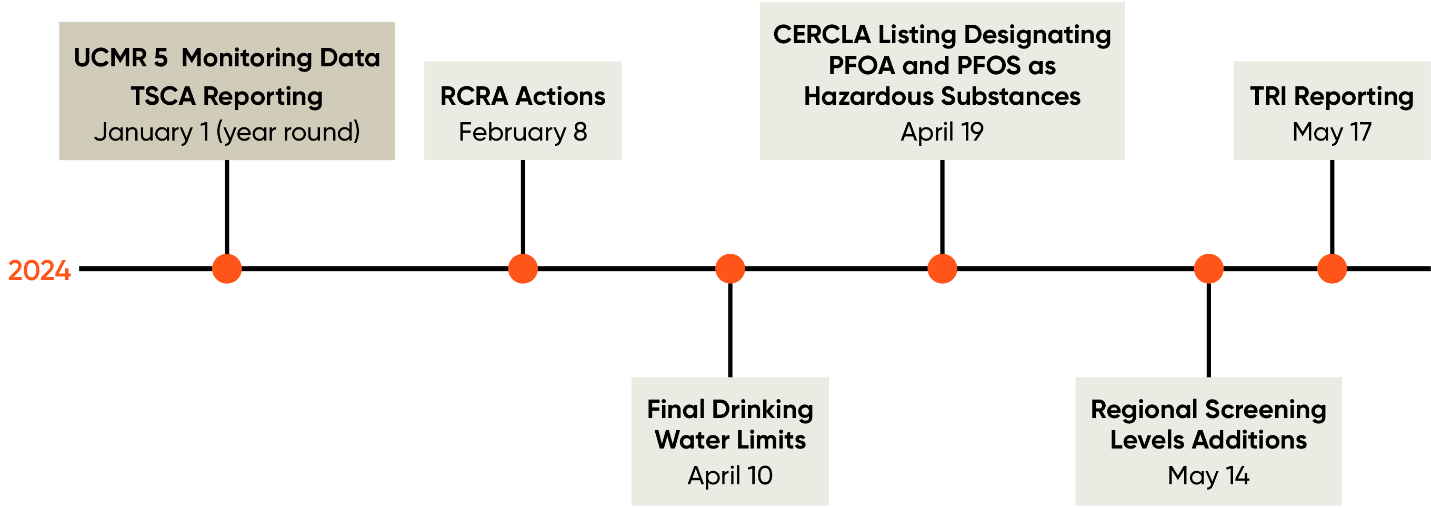
It may not be surprising that 2024 was an expansive year for PFAS regulations at the federal level. EPA advanced significant actions under a range of different regulatory programs and environmental statutes including the Safe Drinking Water Act[iv] (“SDWA”), Comprehensive Environmental Response, Compensation, and Liability Act[v] (“CERCLA”), the Toxic Substances Control Act[vi] (“TSCA”), the Toxics Release Inventory (“TRI”) Program,[vii] and the Resource Conservation and Recovery Act[viii] (“RCRA”).
While not intended to be a complete list, the following is an overview of some key developments in 2024.[ix]
Drinking Water Actions
Drinking water impacts from PFAS have been a major driver for regulatory action at both the federal and state levels over the past few years, culminating with EPA’s decision to issue final drinking water limits for six PFAS compounds in April 2024.
Final Drinking Water Limits
On April 10, 2024, EPA issued[x] a National Primary Drinking Water Regulation (“NPDWR”)[xi] establishing Maximum Contaminant Levels (“MCLs”) and Maximum Contaminant Level Goals (“MCLGs”)[xii] for certain PFAS substances in drinking water. The applicable details[xiii] are summarized below:
|
Compound
|
MCLs (enforceable)
|
MCLGs (non-enforceable)
|
|
PFOA
|
4.0 ppt
|
0 (Zero)
|
|
PFOS
|
4.0 ppt
|
0 (Zero)
|
|
PFHxS
|
10 ppt
|
10 ppt
|
|
PFNA
|
10 ppt
|
10 ppt
|
|
HFPO-DA (known as GenX Chemicals)
|
10 ppt
|
10 ppt
|
|
Mixtures containing two or more of these four PFAS substances: PFHxS, PFNA, HFPO-DA, and PFBS
|
1 (unitless)
Hazard Index
|
1 (unitless)
Hazard Index
|
The concentration limits in the MCLs (enforceable limits) are extremely low – 4-10 parts per trillion (“ppt”), depending on the compound – and the MCLGs (non-enforceable goals) are even lower (in some cases 0 ppt). EPA has suggested that it will continue to reduce the MCLs over time as test methods improve to try to reach the MCLGs. These stringent, but uniform, drinking water limits will apply to drinking water systems across the country, and go into effect in 2029, although drinking water systems must start monitoring against these standards in the interim.
In many cases the cost of compliance for drinking water systems is significant, which has sparked substantial litigation, particularly with respect to water utilities and their wastewater users, as utilities continue to implement enhanced treatment technology to comply with the limits. There have been large settlements[xiv] for drinking water systems in the past several years, but notably, many water systems opted out, so BCLP expects that litigation will continue in the future.
Monitoring Data
EPA is further requiring the ongoing monitoring of other PFAS constituents that are not currently regulated through MCLs, and released the sixth set of data[xv] from the fifth Unregulated Contaminant Monitoring Rule (“UCMR 5”)[xvi] for Public Water Systems (“PWS”). This monitoring is required pursuant to the SDWA,[xvii] which requires that once every five years the EPA issue a list of unregulated contaminants to be monitored by PWS. UCMR 5 covers 30 chemical substances, 29 of which are PFAS compounds. Thus far, data collected from 55% of PWS has been reported,[xviii] and EPA intends to update this information quarterly. PWSs have already raised concerns about the testing costs and the limited availability of qualified laboratories, making compliance with UCMR 5 a continued burden for regulated PWS entities in 2025 and beyond. Conversely, the data included in these reports will continue to illustrate how PFAS is entering drinking water systems across the country, which could inform future permitting and enforcement actions by EPA or state agencies.
CERCLA and Site Screening
CERCLA Hazardous Substances Designation
On April 19, 2024, EPA designated two predominant forms of PFAS, perfluorooctanoic acid (“PFOA”) and perfluorooctanesulfonic acid (“PFOS”), as Hazardous Substances[xix] under CERCLA.[xx] The listing allows EPA to require responsible parties at federal cleanup sites to investigate and remediate impacts from these two compounds, and creates the possibility of potential reopening of closed remediation sites. Further, it will create significant ripple effects that will impact M&A and real estate due diligence, cost recovery litigation, and state regulatory obligations that are tied to the CERCLA list of Hazardous Substances. For example, PFOA and PFOS will now need to be evaluated in all Phase I Environmental Site Assessments for real estate transactions in order for buyers to satisfy the All Appropriate Inquiries Standard,[xxi] meaning that these compounds will now be a consideration in every commercial real estate transaction across the country.
One of the significant concerns is how the CERCLA listing will impact the liability of “passive” receivers of PFAS such as landfills, publicly owned treatment works, PWS, airports, fire departments, and farms that have applied biosolids. As a result, on April 19, 2024, EPA released a non-enforceable memorandum entitled “PFAS Enforcement Discretion and Settlement Policy Under CERCLA,” which provides “direction to all EPA enforcement and compliance staff about how EPA will exercise its enforcement discretion under CERCLA in matters involving PFAS,” expressly authorizing enforcement discretion for these passive users subject to relevant considerations.[xxii] This advisory document underscores EPA’s desire to focus its enforcement efforts on PFAS manufacturers and others who either manufacture PFAS or use PFAS in their manufacturing processes.
Site Screening
With respect to site screening, EPA added several PFAS compounds[xxiii] to its Regional Screening Levels (“RSLs”)[xxiv] for soil, used for risk-based screening at potentially impacted sites. The RSLs are not binding concentration limits or cleanup standards, but are applied by EPA and some state agencies to evaluate whether a potentially impacted site warrants further investigation. EPA’s RSLs for PFAS compounds are extremely low, which raises questions about the number of sites that will have additional investigations and characterizations for PFAS, especially considering the perceived ubiquitous nature of these compounds in many areas.
TSCA and TRI Reporting – Impacts to Supply Chain
TSCA Reporting
EPA issued TSCA Rule 8(a)(7)[xxv] imposing new PFAS reporting requirement under TSCA. [xxvi] Manufacturers, including importers, are required to report by January 11, 2026. PFAS compounds that fall within certain definitional categories are required to be submitted, such as those that were either manufactured within or imported into the United States, or included in articles imported into the United States, between January 1, 2011 and December 31, 2022. Unlike many prior TSCA rules, articles (i.e., finished goods) are not exempt from the requirements of the rule, so businesses that imported articles which contained PFAS compounds during the reporting period have an investigation obligation and may have a reporting obligation. The reporting window was extended, and now opens on July 11, 2025, and all reports (other than those for small businesses) must be submitted by January 11, 2026. The diligence exercise required to comply with the Rule, and the extent of the information that must be reported, is quite comprehensive, although exemptions for certain industries do apply.[xxvii]
TRI Reporting
Under the TRI Program, companies have a reporting obligation if they manufacture, process, or otherwise use any of the listed compounds above their reporting thresholds. Initially, the National Defense Authorization Act required EPA to add over 170 PFAS compounds to the TRI list in 2020. EPA added seven (7) additional PFAS substances in 2024,[xxviii] and nine additional PFAS compounds in 2025,[xxix] bringing the total to 205 PFAS substances in the TRI program. TRI reports for 2024 are due on July 1, 2025.[xxx]
RCRA Actions
EPA proposed two separate actions under RCRA in 2024, neither of which has been finalized.
Hazardous Constituents
EPA submitted an amendment to the RCRA regulations to designate nine PFAS (and their salts and structural isomers) as Hazardous Constituents.[xxxi] Among other requirements, Hazardous Constituents must be considered in RCRA facility assessments, and if appropriate, remediated through the RCRA corrective action process.
Definition of Hazardous Waste
EPA sought to modify the definition of Hazardous Waste to allow it “to fully implement EPA’s statutory authority to require corrective action to address releases not only of substances identified as hazardous waste in the regulations but of any substance that meets the statutory definition of hazardous waste.”[xxxii] Accordingly, regulators have initiated RCRA corrective action authority to address emerging contaminants, such as PFAS. EPA can utilize corrective action to address releases of all the substances that RCRA encompasses.
Anticipated Actions in 2025
At this time, it is unclear how the Trump Administration may differ from the Biden Administration with respect to PFAS regulation and enforcement. That noted, it may be more difficult for the administration to quickly unwind existing regulations, since it would require formal agency or congressional action.
For instance, on January 20, 2025, newly inaugurated President Donald Trump issued an Executive Order “freezing” all proposed rules already submitted to the Federal Register until an agency designated by the President reviews the rule. [xxxiii] As a result, on January 21, 2025, the Office of Management and Budget (“OMB”) revoked the “Clean Water Act Effluent Limitations Guidelines and Standards for PFAS Manufacturers Under the Organic Chemicals, Plastics, and Synthetic Fibers Point Source Category,” which proposed wastewater effluent limits for PFAS from certain chemicals manufacturers.[xxxiv] However, on January 29, 2025, the OMB reversed this ”freeze,”[xxxv] underscoring the current uncertainty regarding this action.
On February 7, 2025, the D.C. Circuit Court of Appeals held a matter in abeyance for 60 days to allow new EPA leadership to review the April 2024 rule entitled “PFAS National Primary Drinking Water Regulation.”[xxxvi] Therefore, several proposed rules regarding PFAS may be reevaluated soon, causing regulatory uncertainty.
The PFAS Hazardous Substances listing under CERCLA is also in question. Specifically, the Heritage Foundation’s Project 2025 “Mandate for Leadership: The Conservative Promise” states that it will “[r]evisit the designation of PFAS chemicals as ‘hazardous substances’ under CERCLA.”[xxxvii] Notably, this is the first time that EPA has designated a substance as a Hazardous Substance under CERCLA 102(a) authority,[xxxviii] and EPA is already defending a suit filed by the US Chamber of Commerce[xxxix] challenging the listing. In June 2024, the U.S. Supreme Court issed the Loper Bright decision,[xl] which eliminated decades of precedent based on the Chevron doctrine and instead requires individual courts to “exercise their independent judgment,” and not to accept an agency’s opinion if the agency acted outside of its “statutory authority.”[xli] Whether the Hazardous Substance designation will be judicially invalidated is unclear.
How the Trump Administration will approach the federal regulation (or deregulation) of PFAS remains to be seen. At a minimum, PFAS has not been an issue that the administration has initially heralded as an enforcement or regulatory priority. But federal deregulation or enforcement freezes may result in additional private party action, such as private parties seeking cost recovery from potentially responsible parties under CERCLA, as already started in 2024. States may also continue additional rule making with respect to PFAS cleanup levels, such as in the soil and groundwater, and may also take further steps to regulate PFAS in commerce or in other environmental media, such as the air.
Conclusion
In 2024, EPA continued to focus heavily on regulating PFAS compounds, resulting in final and enforceable standards under several key environmental statutes. Looking ahead, despite the uncertain priorities of the incoming administration, states are expected to continue to pursue more regulations and enforcement to supplement federal action. Businesses that historically or currently interact with these compounds should consider identifying and evaluating their potential risk and reporting obligations.
[i] See U.S. Envtl. Protection Agency, Per- and polyfluoroalkyl substances, January 7, 2025.
[ii] Joseph J. Shearer et al., Serum Concentrations of Per- and Polyfluoroalkyl Substances and Risk of Renal Cell Carcinoma, J. of the Nat’l Cancer Inst., September 2020.
[iii] U.S. Envtl. Protection Agency, Our Current Understanding of the Human Health and Environmental Risks of PFAS, November 26, 2024.
[iv] See 42 U.S.C. §300f et seq. (1974).
[v] See 42 U.S.C. §9601 et seq. (1980).
[vi] See 15 U.S.C. §2601 et seq. (1976).
[vii] U.S. Envtl. Protection Agency, Toxics Release Inventory (TRI) Program, January 16, 2025.
[viii] See 42 U.S.C. §6901 et seq. (1976).
[ix] Many of these developments were highlighted in U.S. Envtl. Protection Agency, PFAS Strategic Roadmap: Third Annual Progress Report (November 2024) and Nat’l Science & Tech.Council, PFAS Federal Research and Development Plan (August 2024).
[x] U.S. Envtl. Protection Agency, Biden-Harris Administration Finalizes First-Ever National Drinking Water Standard to Protect 100M People from PFAS Pollution, April 19, 2024.
[xi] U.S. Envtl. Protection Agency, Final PFAS National Primary Drinking Water Regulation, April 10, 2024.
[xii] U.S. Envtl. Protection Agency, How EPA Regulates Drinking Water Contaminants, October 21, 2024.
[xiii] See Final PFAS National Primary Drinking Water Regulation, supra note 11.
[xiv] Miles Scully & Brian Ledger, PFAS settlements: Future of PFAS litigation landscape to be determined by upcoming decision, Reuters, August 31, 2023.
[xv] U.S. Envtl. Protection Agency, Occurrence Data from the Unregulated Contaminant Monitoring Rule, October 2024.
[xvi] U.S. Envtl. Protection Agency, Fifth Unregulated Contaminant Monitoring Rule, December 27, 2021.
[xvii] See 42 U.S.C. §300f et seq. (1974).
[xviii] See Occurrence Data, supra note 15.
[xix] See Biden-Harris Administration, supra note 10.
[xx] See 42 U.S.C. §9601 et seq. (1980).
[xxi] U.S. Envtl. Protection Agency, All Appropriate Inquiries Final Rule Factsheet.
[xxii] U.S. Envtl. Protection Agency, PFAS Enforcement Discretion and Settlement Policy Under CERCLA, April 19, 2024.
[xxiii] U.S. Envtl. Protection Agency, Regional Screening Levels (RSLs) - What's New, November 13, 2024.
[xxiv] U.S. Envtl. Protection Agency, Regional Screening Levels (RSLs) - Generic Tables, November 13, 2024.
[xxv] U.S. Envtl. Protection Agency, TSCA Section 8(a)(7) Reporting and Recordkeeping Requirements for Perfluoroalkyl and Polyfluoroalkyl Substances, October 11, 2023.
[xxvii] Reporting and Recordkeeping Requirements, supra note 25.
[xxviii] U.S. Envtl. Protection Agency, Addition of Certain PFAS to the TRI by the National Defense Authorization Act, May 17, 2024.
[xxix] U.S. Envtl. Protection Agency, EPA Adds Nine Additional PFAS to the Toxics Release Inventory, January 3, 2025.
[xxx] Addition of Certain PFAS, supra note 28.
[xxxi] U.S. Envtl. Protection Agency, Proposal to List Nine Per- and Polyfluoroalkyl Compounds as Resource Conservation and Recovery Act Hazardous Constituents, February 8, 2024.
[xxxiii] Exec. Order No. 2025-01906, 90 Fed. Reg. 8249 (January 20, 2025).
[xxxiv] Riley Griffin, Skylar Woodhouse, and Gregory Korte, White House Reverses Spending Freeze That Sparked Chaos, Bloomberg Law, January 29, 2025.
[xxxvi] American Water Works Assoc. et al. v. EPA et. al., No. 24-1188 (D.C. Cir. Feb. 7, 2025).
[xxxvii] Project 2025: Mandate for Leadership: The Conservative Promise, Heritage Found. (Paul Dans & Steven Groves eds., 2023), at 431.
[xl] Loper Bright Enterprises et al. v. Raimondo, 603 U. S. 369 (2024).




 Home
Home
